
 OTHERS
BTTS Tips And Stats: How To Find The Best Bets
At Pikibet, we completely discard lazy, copy-paste narratives and emotional fan bias. Instead, we approach upcoming football matches with the mindset of a data analyst tracking market inefficiencies.
While the vast majority of casual punters reflexively pour their capital into highly unpredictable outright winner lines, professional sports analysts recognize that the Both Teams to Score (BTTS) market frequently represents one of the most consistently mispriced zones on a bookmaker’s board.
Isolating a sustainable BTTS edge isn’t about chasing teams that are just “due a goal.” It requires a highly structured filtration process that identifies match profiles where low defensive concentration, strong attacking geometries, and specific venue efficiency metrics mathematically override clean-sheet probabilities.
Strategic Risk Reminder: The BTTS market is a variance-heavy environment that requires extreme capital discipline.
Within a professional tracking framework, terms like sure BTTS, guaranteed goals, or banker systems are entirely rejected.
They are purely statistical probability models—never financial guarantees. Protect your active bankroll by implementing strict flat-staking controls across your entire slate.
What Does BTTS Mean?
For the absolute beginner, it is crucial to first establish the baseline parameter. BTTS stands strictly for Both Teams to Score.
This market simplifies the 90-minute regulation outcome to a binary (Yes/No) configuration: will both competing sides find the back of the net at least once during regulation play, regardless of the final outcome?
Under this setup, the identity of the match winner is completely irrelevant. A $1\text{–}1$ draw is a winning selection. A $5\text{–}1$ blowout is a winning selection.
Conversely, a dominant $4\text{–}0$ home victory results in a loss for the “Yes” market because the visiting side failed to breach the opposing backline.
The market has gained massive global popularity because it keeps a bet active up until the final whistle.

What’s The Probability of BTTS?
Isolating the true probability of both teams scoring is where a professional analysis system separates itself from amateur guesswork.
Bookmakers systematically overprice “No” outcomes and shade “Yes” odds downward due to high public demand, creating a critical need for $+EV$ (Positive Expected Value) identification.
Our forecasting engine determines accurate probabilities by evaluating upcoming fixtures using three primary quantitative indicators:
Predicting BTTS (Yes) means calculating the probability that both teams exceed zero goals. Because goal distributions across 90 minutes are not random, professional models must navigate this high-variance environment safely.
Our background engines discard random guesswork and deploy a specialized Poisson Distribution framework. This mathematical system runs a team’s rolling offensive generation metrics against an opponent’s travel-specific defensive capabilities to map out precise percentage weights for standard score configurations:
$$P(x; \mu) = \frac{e^{-\mu} \mu^x}{x!}$$
- Primary BTTS (Yes) Probability: Elevated when simulations show a strong likelihood of $1\text{–}1$, $2\text{–}1$, or $2\text{–}2$ scorelines based on mutual defensive vulnerabilities and attacking strengths.
- BTTS (No) Probability: Isolated in matches projected for low volatility ($0\text{–}0$, $1\text{–}0$, or $0\text{–}1$), often found in high-stakes finals or between teams deploying ultra-conservative defensive blocks.
How to Predict BTTS?
Successfully mapping out the likelihood of both teams breaching opposing defenses requires a systematic deep dive into venue-specific performance matrices.
While many factors contribute to a high-scoring game, professional forecasting systems must scale data that specifically targets reciprocal goalscoring.
Our analytical pipeline uses a structured, venue-weighted filtration to determine the optimal BTTS (Yes) targets:
- 1. Track Isolated League Goal Averages: Target open, high-tempo leagues (like the German Bundesliga or Dutch Eredivisie) while filtering out low-scoring, defensive divisions.
- 2. Strip Away Clean Sheet Outliers: Identify teams whose defensive stats are padded by low-tier opposition and evaluate how they perform against top-half attacking structures.
- 3. Factor in Tactical Intent: Assess whether a team is likely to deploy a defensive low-block on the road or attempt an aggressive, high-pressing transition game.
Away Team Scored % & Home Team Conceded %
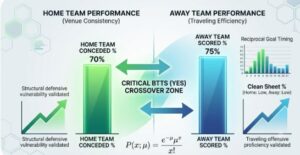
The absolute core of any elite BTTS model relies on a specific reciprocal relationship. To mathematically validate a “Yes” selection, the data must show a high overlap between the traveling attack and the hosting defense.
1. Away Team Scored %
Our system scales the probability of the visiting team navigating the home advantage barrier to find a goal. This is a crucial multiplier: an elite attacking visiting club with a high scoring consistency (e.g., scoring in 75%+ of traveling fixtures) drastically raises the floor of the match volatility profile.
2. Home Team Conceded %
We strictly evaluate the host’s baseline inability to maintain a clean sheet at their own venue. A high domestic conceded rate (e.g., conceding in 70%+ of home games) signals defensive vulnerabilities that visiting teams routinely exploit. When this is paired with a strong Away Team Scored %, the algorithmic probability of BTTS surges toward maximum validation.
The visualization below isolates this specific crossover point. The model looks for the critical geometric intersection where the traveling team’s offensive efficiency perfectly exploits the home team’s defensive vulnerability:
Universal Capital Protection Controls for Global Slips
Operating a successful sports tracking portfolio requires strict asset management controls. Without a disciplined financial strategy, a standard run of negative variance will quickly deplete your operational capital.
- Enforce Flat Betting Sizing: Treat your operational bankroll strictly as investment capital rather than disposable income. Professional models dictate risking a consistent, level stake of 1% to 3% of your total operational capital per position. This disciplined sizing ensures your portfolio can easily withstand natural competitive variance without depleting your primary resources.
- Mitigate Multi-Bet Liability: Accumulators (Cược xiên / マルチベット / Múltiplas) scale potential returns but introduce significant risk by compounding your points of failure. Stacking multiple selections into speculative tickets multiplies your risk parameters. Keep your tracking slips limited to single selections or high-efficiency two-match doubles on Pikibet to protect your slate.
faq
Q1: Why are the odds for BTTS (Yes) often lower than outright win markets? Because the public loves betting on high-scoring games, bookmakers frequently shade the “Yes” odds downwards to minimize their financial liability, especially in high-profile fixtures. This requires finding $+EV$ value via other specialized derivatives or niche leagues.
Q2: Which football leagues are best for generating high BTTS statistics? Leagues characterized by open, high-intensity attacking football—such as the German Bundesliga, the Dutch Eredivisie, and various primary divisions in Latin America—historically generate the most stable BTTS (Yes) statistical profiles.
Q3: How do head-to-head (H2H) statistics impact your BTTS probability modeling? Historical H2H data is secondary to recent venue form but still highly relevant. It flags deeply ingrained tactical matchup geometry, showing if certain managers always prioritize defensive low-blocks against each other, drastically reducing goal probabilities.
Q4: How frequently does the Pikibet BTTS filtration engine update its selections? Our automated servers refresh data models every hour. Sudden shifts in squad depth (e.g., a key goalkeeper out), sharp opening exchange line drops, or localized weather adjustments are instantly calculated into the live dashboard.
conclusion
The Both Teams to Score (BTTS) market represents one of the most under-explored areas for building a long-term sports tracking edge.
By shifting away from emotional guessing and replacing it with automated algorithmic filtration, serious sports researchers can systematically challenge the bookmaker’s opening line.
By tracking the critical data crossover between Away Team Scored % and Home Team Conceded %, you can transition from emotional speculation to evidence-based analysis.
Pair these highly filtered daily selections with strict flat-staking controls, multi-platform validation, and consistent line tracking to let mathematics transform your sports analysis on Pikibet.
 All tip stores
 Home
Home
 VIP Packages
 Blog
Blog
 Archives
 Winnings